Back

Back

Back

Cash is a king

Working Capital Reality

B2G companies fail on timing, not margins. Verter Studio models working capital reality by linking revenue recognition, AR/AP delays, and cash availability in one coherent system.

2 min read
Working Capital Reality

Working Capital Reality

There's a silent killer in startups that doesn't show up in most financial models, and it's called working capital. Your profit and loss statement says you're making money. Your balance sheet looks healthy on paper. But your bank account is empty, and you're not sure how you're going to make payroll next month.

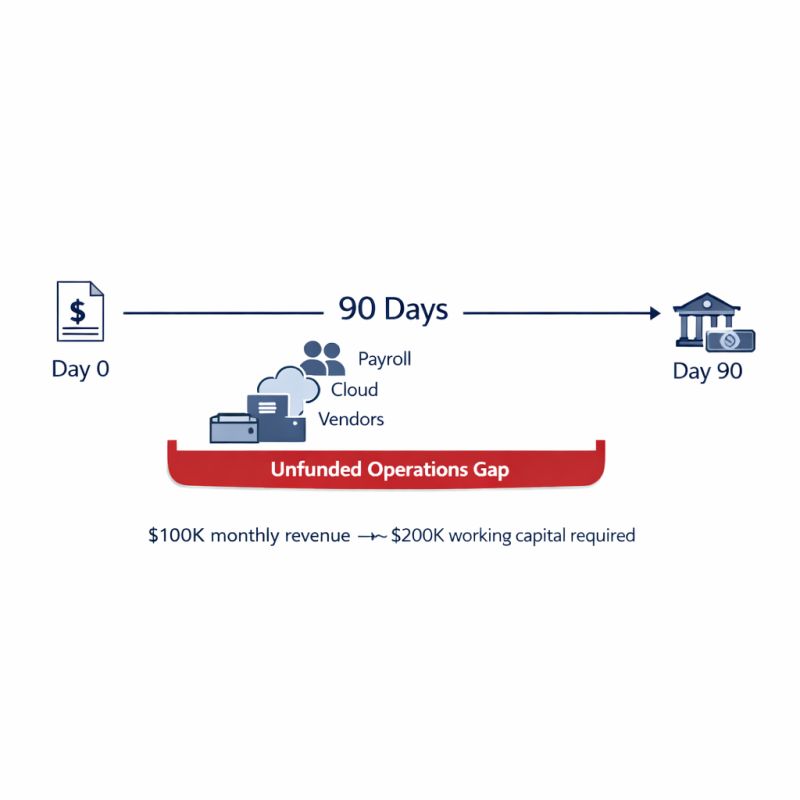
The mechanics are simple but brutal. In B2G, your customers typically pay in ninety days. That's the standard — not the worst case, just the normal expectation. Meanwhile, your vendors want to be paid in thirty days, your employees expect their salaries twice a month, and your cloud hosting bill doesn't wait for government procurement cycles. The gap between when you incur costs and when you receive payment is sixty days of unfunded operations.

Let me make this concrete. If you're generating one hundred thousand dollars in monthly revenue from government contracts, you need roughly two hundred thousand dollars in working capital reserves just to bridge the timing gap. That's money sitting in your account doing nothing except keeping the lights on while you wait for checks to clear. Most founders don't budget for this, and it catches them off guard.

The problem compounds when you're growing. Every new contract means more implementation costs paid upfront, more team members to hire, more months of bridge financing until the revenue actually arrives. Growth in B2G isn't just an opportunity — it's a cash requirement, and many promising companies have failed not because their product didn't work but because they ran out of runway waiting to get paid.

This is why Verter Studio integrates all three financial statements: profit and loss, balance sheet, and cash flow. They're fully linked, so when you change an AR days assumption from thirty to ninety, the impact ripples through your entire model. You see not just what you've earned, but when you'll actually have the cash.
→ AR Days: 90 is government standard, 120+ is common for municipal
→ AP Days: 30 is typical for your vendors
→ The gap creates months of unfunded operations
→ Every $100K in monthly revenue needs ~$200K in reserves

View more articles

Learn actionable strategies, proven workflows, and tips from experts to help your product thrive.

Cash is a king

VENTURE CAPITAL, ACCELERATORS, AND B2G STARTUPS - The Infrastructure Gap in Financial Planning for Business-to-Government Companies

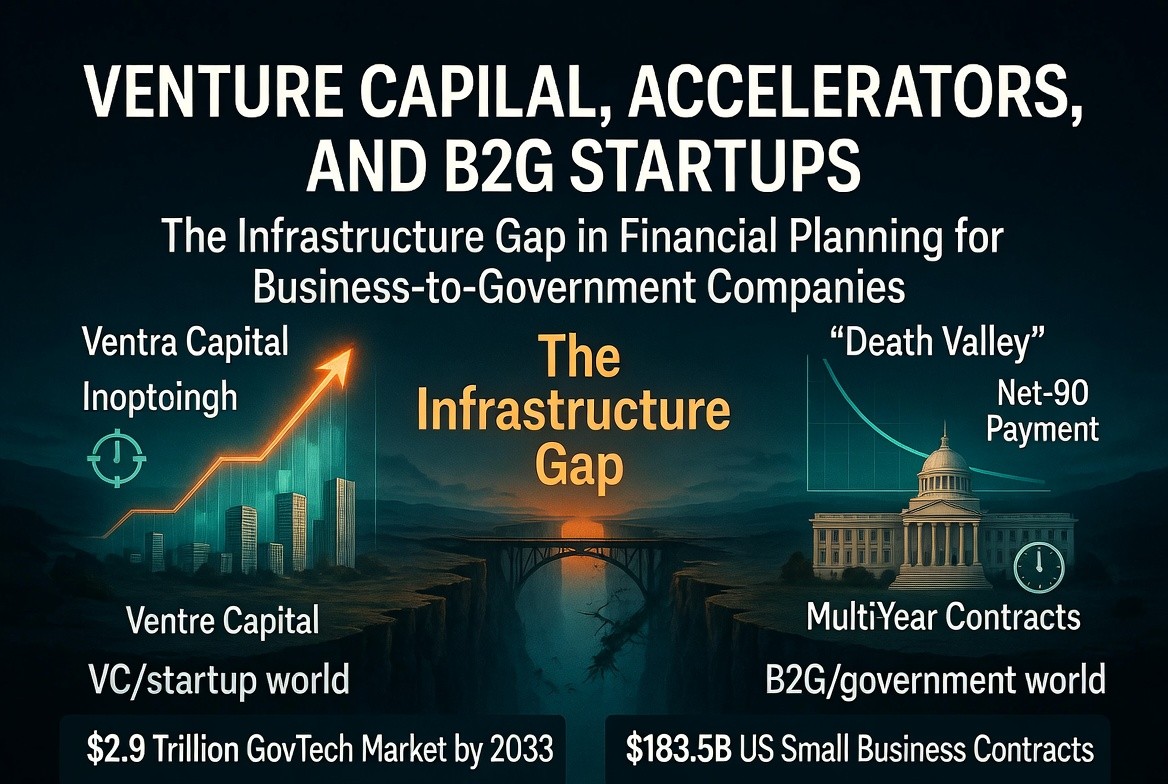
$183.5 billion. That's how much the US federal government awarded to small businesses in FY 2024 — an all-time record. The GovTech market is projected to hit $2.9 trillion by 2033. Funding is surging. Accelerators are multiplying. Government innovation offices are actively seeking startup partners. And yet, B2G startups keep dying. Not because their products fail. Not because the market isn't there. Because the financial tools they rely on — the same MRR-based templates, SaaS churn models, and linear growth projections that work beautifully for consumer software — are structurally incapable of modeling how government contracts actually work. Net-90 payment terms. Milestone-based invoicing. Multi-year commitments. S-curve adoption with 12–24 months of "Death Valley" before revenue accelerates. Working capital gaps that can exceed $500,000 before a single dollar arrives. Standard financial models hide all of this. The result: founders make spending decisions based on phantom revenue. Investors misprice risk using metrics designed for a different business model entirely. Accelerators evaluate companies with scorecards that don't match the operating reality those companies will face. We analyzed 50+ financial planning tools across four market segments. The finding: zero specifically address B2G revenue recognition, contract-based churn, or government payment cycle modeling. Not at the $150K enterprise tier. Not at the $300 template tier. Nowhere. We also examined regulatory requirements from the US GAO, UK Cabinet Office, and OECD — all of which mandate vendor financial viability assessment but offer no standardized framework for early-stage companies. The full report, "Venture Capital, Accelerators, and B2G Startups: The Infrastructure Gap in Financial Planning for Business-to-Government Companies," is a 20-page analytical deep-dive covering the VC blind spot, the accelerator paradox, the regulatory dimension, and what contract-aware financial infrastructure should actually look like.

Cash is a king

VENTURE CAPITAL, ACCELERATORS, AND B2G STARTUPS - The Infrastructure Gap in Financial Planning for Business-to-Government Companies

$183.5 billion. That's how much the US federal government awarded to small businesses in FY 2024 — an all-time record. The GovTech market is projected to hit $2.9 trillion by 2033. Funding is surging. Accelerators are multiplying. Government innovation offices are actively seeking startup partners. And yet, B2G startups keep dying. Not because their products fail. Not because the market isn't there. Because the financial tools they rely on — the same MRR-based templates, SaaS churn models, and linear growth projections that work beautifully for consumer software — are structurally incapable of modeling how government contracts actually work. Net-90 payment terms. Milestone-based invoicing. Multi-year commitments. S-curve adoption with 12–24 months of "Death Valley" before revenue accelerates. Working capital gaps that can exceed $500,000 before a single dollar arrives. Standard financial models hide all of this. The result: founders make spending decisions based on phantom revenue. Investors misprice risk using metrics designed for a different business model entirely. Accelerators evaluate companies with scorecards that don't match the operating reality those companies will face. We analyzed 50+ financial planning tools across four market segments. The finding: zero specifically address B2G revenue recognition, contract-based churn, or government payment cycle modeling. Not at the $150K enterprise tier. Not at the $300 template tier. Nowhere. We also examined regulatory requirements from the US GAO, UK Cabinet Office, and OECD — all of which mandate vendor financial viability assessment but offer no standardized framework for early-stage companies. The full report, "Venture Capital, Accelerators, and B2G Startups: The Infrastructure Gap in Financial Planning for Business-to-Government Companies," is a 20-page analytical deep-dive covering the VC blind spot, the accelerator paradox, the regulatory dimension, and what contract-aware financial infrastructure should actually look like.

Cash is a king

VENTURE CAPITAL, ACCELERATORS, AND B2G STARTUPS - The Infrastructure Gap in Financial Planning for Business-to-Government Companies

$183.5 billion. That's how much the US federal government awarded to small businesses in FY 2024 — an all-time record. The GovTech market is projected to hit $2.9 trillion by 2033. Funding is surging. Accelerators are multiplying. Government innovation offices are actively seeking startup partners. And yet, B2G startups keep dying. Not because their products fail. Not because the market isn't there. Because the financial tools they rely on — the same MRR-based templates, SaaS churn models, and linear growth projections that work beautifully for consumer software — are structurally incapable of modeling how government contracts actually work. Net-90 payment terms. Milestone-based invoicing. Multi-year commitments. S-curve adoption with 12–24 months of "Death Valley" before revenue accelerates. Working capital gaps that can exceed $500,000 before a single dollar arrives. Standard financial models hide all of this. The result: founders make spending decisions based on phantom revenue. Investors misprice risk using metrics designed for a different business model entirely. Accelerators evaluate companies with scorecards that don't match the operating reality those companies will face. We analyzed 50+ financial planning tools across four market segments. The finding: zero specifically address B2G revenue recognition, contract-based churn, or government payment cycle modeling. Not at the $150K enterprise tier. Not at the $300 template tier. Nowhere. We also examined regulatory requirements from the US GAO, UK Cabinet Office, and OECD — all of which mandate vendor financial viability assessment but offer no standardized framework for early-stage companies. The full report, "Venture Capital, Accelerators, and B2G Startups: The Infrastructure Gap in Financial Planning for Business-to-Government Companies," is a 20-page analytical deep-dive covering the VC blind spot, the accelerator paradox, the regulatory dimension, and what contract-aware financial infrastructure should actually look like.