Business Case
Cost Structure Breakdown
B2G businesses have a more complex cost structure, and getting it right matters for understanding your actual unit economics. Implementation isn't free — there are often subcontractor costs, partner fees, setup labor that varies by customer segment. Third-party licenses might be billed annually per user or per transaction. Delivery costs might include SMS notifications, payment processing with different rates for different payment types, or API calls to government systems.
When most founders think about cost of goods sold, they think about hosting costs and maybe payment processing fees. It's a simple mental model that works for straightforward SaaS businesses: you pay Amazon some money for servers, you pay Stripe some money for transactions, and whatever's left is gross profit. Clean, easy to calculate, easy to explain.
B2G businesses have a more complex cost structure, and getting it right matters for understanding your actual unit economics. Implementation isn't free — there are often subcontractor costs, partner fees, setup labor that varies by customer segment. Third-party licenses might be billed annually per user or per transaction. Delivery costs might include SMS notifications, payment processing with different rates for different payment types, or API calls to government systems.
The challenge is that these costs don't all behave the same way. Some are truly fixed — you pay them once regardless of usage. Some scale with customers, some scale with transactions, some scale with users within a customer. A cost that's fixed per contract but variable per user creates different margin dynamics than a cost that's a percentage of revenue. Most templates force you to pick one model and apply it everywhere.
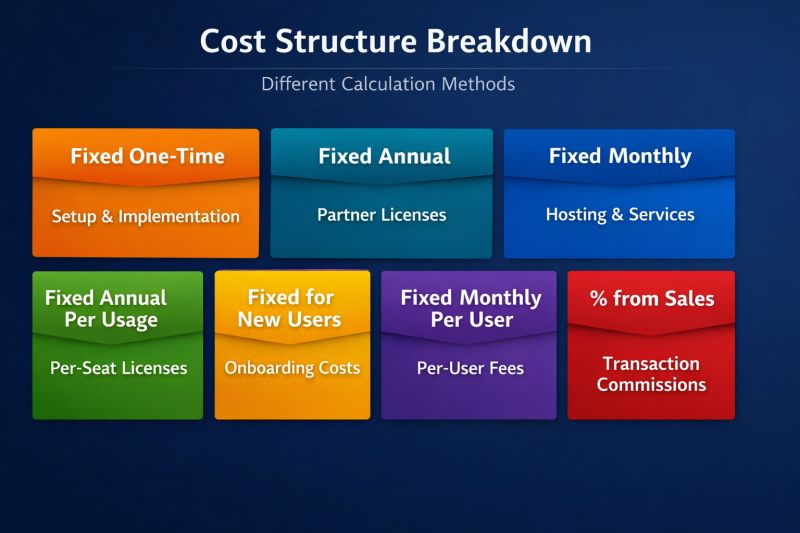
The Verter Studio framework supports seven different cost calculation methods, and you can apply different methods to different products and different customer segments. Fixed one-time costs for setup. Fixed annual costs spread over the contract. Fixed monthly costs that recur regardless of usage. Annual costs per seat. One-time costs per new user. Monthly costs per active user. Percentage of sales for transaction-based fees.
This granularity matters because it lets you see gross margin by customer segment, by product, and by revenue type. You might discover that your enterprise segment has great margins but your small-government segment is underwater once you account for implementation costs. You might find that your transaction fee revenue has much worse margins than your license revenue because of payment processor costs. These insights are invisible if you're using a simple "hosting plus processing" cost model.
→ Fixed One Time: Setup, implementation, onboarding
→ Fixed Annual: Partner licenses spread over contract
→ Fixed Monthly: SaaS fees, hosting, recurring services
→ Fixed Annual Per Usage: Per-seat annual licenses
→ Fixed for New Users: Onboarding cost per user added
→ Fixed Monthly per User: Per-seat cloud costs
→ % from Sales: Payment processing, commissions
How granular is your cost modeling, and what might you be missing?
hashtag#COGS hashtag#UnitEconomics hashtag#B2G hashtag#B2B hashtag#SaaS hashtag#FinancialModeling
View more articles
Learn actionable strategies, proven workflows, and tips from experts to help your product thrive.