Scenario planing
Government Customer Segments
Customer segmentation is one of the most underappreciated aspects of B2G financial modeling. Government customers aren't interchangeable — a municipal contract and a federal contract might both involve the same product, but they have completely different sales cycles, payment terms, pricing ceilings, and renewal dynamics. Treating them as one bucket hides the real economics of your business.
1 min
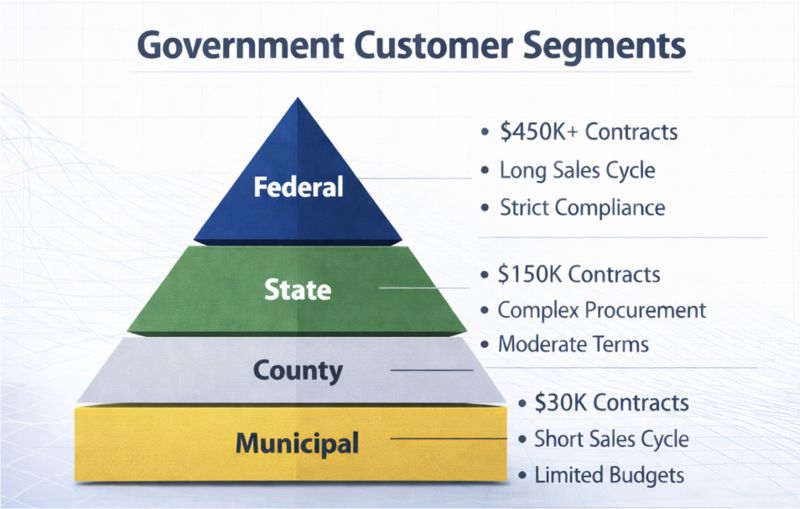
I was talking with a founder recently who told me their average contract value was one hundred thousand dollars. It sounded impressive until I asked a few more questions. Turns out they had three municipal customers at thirty thousand each, one state customer at one hundred fifty thousand, and one federal customer at four hundred fifty thousand. The "average" was mathematically correct but strategically meaningless.
Customer segmentation is one of the most underappreciated aspects of B2G financial modeling. Government customers aren't interchangeable — a municipal contract and a federal contract might both involve the same product, but they have completely different sales cycles, payment terms, pricing ceilings, and renewal dynamics. Treating them as one bucket hides the real economics of your business.
The differences are substantial. Municipal governments typically have smaller budgets and shorter contract terms. State governments can sign larger deals but often have more complex procurement requirements. Federal contracts can be massive but involve compliance requirements and sales cycles that are in their own category. Each segment has a different TAM ceiling, a different cost to acquire, and a different margin profile.
Beyond government level, you might segment by geography (domestic vs international, different regions with different regulations), by product type (platform vs modules vs professional services), or by contract size (pilot deals vs enterprise agreements). The right segmentation depends on where the meaningful differences are in your business — where the economics actually vary enough to matter.
The Verter Studio framework supports segmentation across multiple dimensions. Each segment gets its own market sizing, its own sales cycle assumptions, its own pricing matrix, its own churn rates at renewal. The model then rolls up to consolidated views while preserving the segment-level detail. You can see that your municipal segment loses money on implementation while your federal segment is highly profitable, instead of averaging them into a number that describes neither.
→ Government level: Federal, State, Municipal, County
→ Geography: USA, EU, LATAM, etc.
→ Contract type: Pilot, Standard, Premium, Enterprise
→ Each segment with its own: TAM, sales cycle, pricing, churn rate
How many distinct customer segments do you actually serve, and are you modeling them separately or averaging away the differences?
hashtag#CustomerSegmentation hashtag#B2G hashtag#GovTech hashtag#ProductStrategy
View more articles
Learn actionable strategies, proven workflows, and tips from experts to help your product thrive.