Sales Planing
Team & Revenue relation
There's a common pattern in startup financial models that I've come to think of as the "disconnected spreadsheet" problem. In one tab, you have your revenue projections — customers acquired, contracts signed, revenue recognized. In another tab, you have your team plan — hires by month, salaries, total headcount. The two tabs sit next to each other but never actually talk to each other.
There's a common pattern in startup financial models that I've come to think of as the "disconnected spreadsheet" problem. In one tab, you have your revenue projections — customers acquired, contracts signed, revenue recognized. In another tab, you have your team plan — hires by month, salaries, total headcount. The two tabs sit next to each other but never actually talk to each other.
The problem is that in real businesses, team and revenue are deeply connected. You can't close government contracts without salespeople. You can't deliver implementations without implementation consultants. You can't support and retain customers without a customer success team. The revenue doesn't just happen — it's produced by people you need to hire, train, and pay before the revenue materializes.
Most founders understand this conceptually but don't build it into their models. They'll project aggressive customer acquisition but leave the sales team flat. They'll show implementation revenue growing but not hire the engineers needed to deliver it. The result is a model that implicitly assumes superhuman productivity or unlimited capacity from a fixed team — assumptions that don't survive contact with reality.
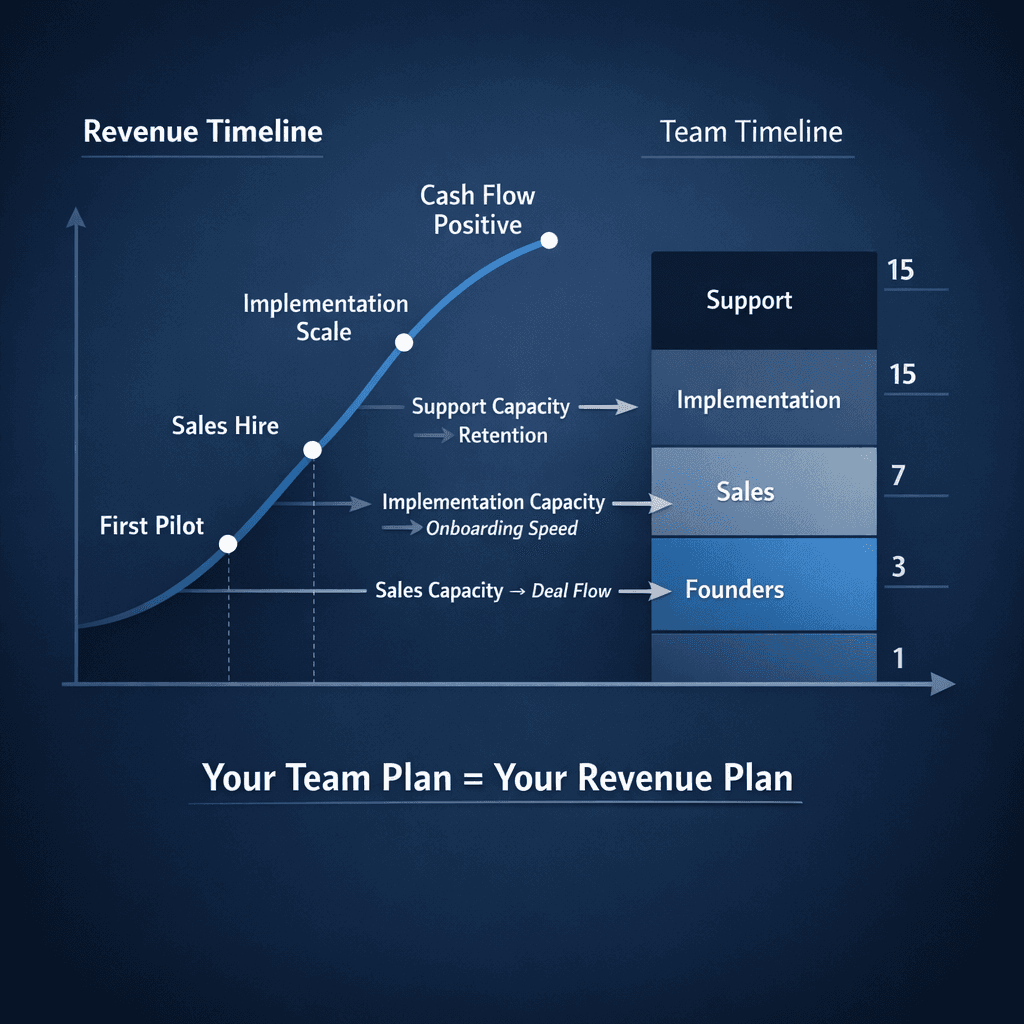
The more sophisticated approach ties hiring to revenue milestones. Months one through six might be founders only, closing the first pilot deals through personal relationships. Month seven you add your first sales hire because you've proven the sales motion and need to scale it. Month thirteen you add implementation capacity because contract volume is outpacing your ability to deliver. The team plan becomes a function of the revenue plan, not a separate exercise.
The Verter Studio framework connects these elements. Your team plan feeds into operating expenses. Your revenue projections imply delivery capacity requirements. When you change one, you can see the impact on the other. It's not magic — you still need to make judgment calls about productivity and hiring timing — but the structure forces you to think about the relationship rather than modeling them as independent.
→ Sales team: Drives pipeline, capacity limits deal flow
→ Implementation team: Enables delivery, constrains how fast you can onboard
→ Support team: Affects retention and renewal rates
→ Your team plan is your revenue plan — model them together
How do you connect headcount to revenue in your model, if at all?
hashtag#TeamBuilding hashtag#StartupHiring hashtag#FinancialPlanning hashtag#HR hashtag#B2B
View more articles
Learn actionable strategies, proven workflows, and tips from experts to help your product thrive.