Business Case
From Business Model Canvas to Investor-Ready Financials: 9 Steps
How to transform your idea to investor and operation ready plan - 9 base steps
2 min read
From Business Model Canvas to Investor-Ready Financials: 9 Steps
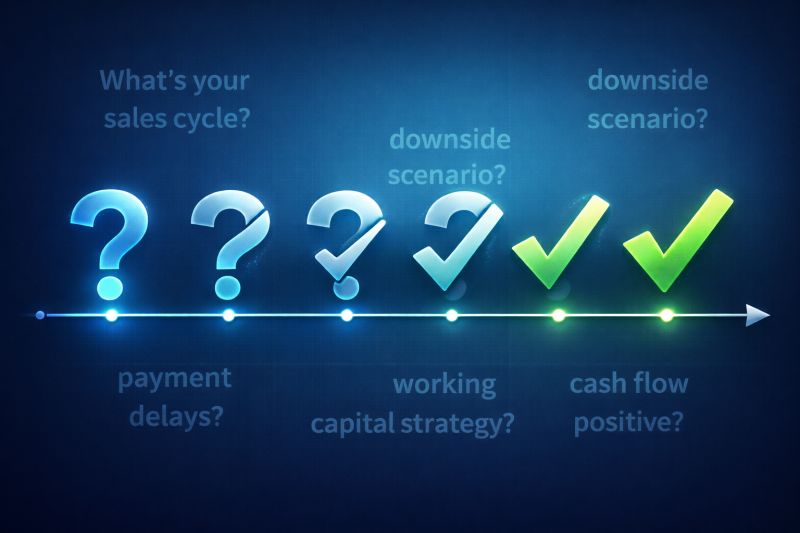
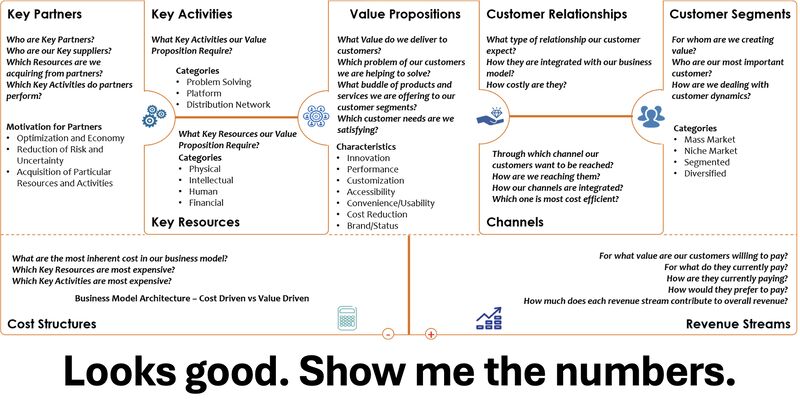
The Canvas is brilliant for mapping your idea on one page. I use it myself. But then reality hits: How do you turn "Value Proposition" into a revenue forecast? How does "Cost Structure" become a three-statement model with cash flow? How do you show the downside scenario when an investor asks "what if everything takes twice as long?"
That's the gap I built the framework to fill. It takes the all BMC blocks and translates them into concrete, calculable financial inputs. And then adds what Canvas can't give you.
1. Customer Segments → Market & Sales Plan TAM by segment, target customers, S-curve acquisition. Not linear fantasy — actual adoption curves.
2. Value Propositions → Products & Services Every product mapped to revenue type — one-time, annual, subscription, transaction, usage-based, professional services.
3. Channels → Sales Cycle & Acquisition How long deals take, what they cost. A 6-month government cycle has completely different cash implications than 30-day SMB.
4. Customer Relationships → Revenue Logic Churn at renewal points, retention, contract mechanics.
5. Revenue Streams → Pricing & Revenue Model What each segment pays for each product. Contract duration. Payment terms. Prepayment logic.
6. Key Resources → CapEx & Investment Servers, IP, equipment — everything capitalized and depreciated properly.
7. Key Activities + Key Partnerships → Team, OpEx & Direct Costs Hiring timeline by role, operating expenses, vendor costs, partner licenses — everything that keeps the business running.
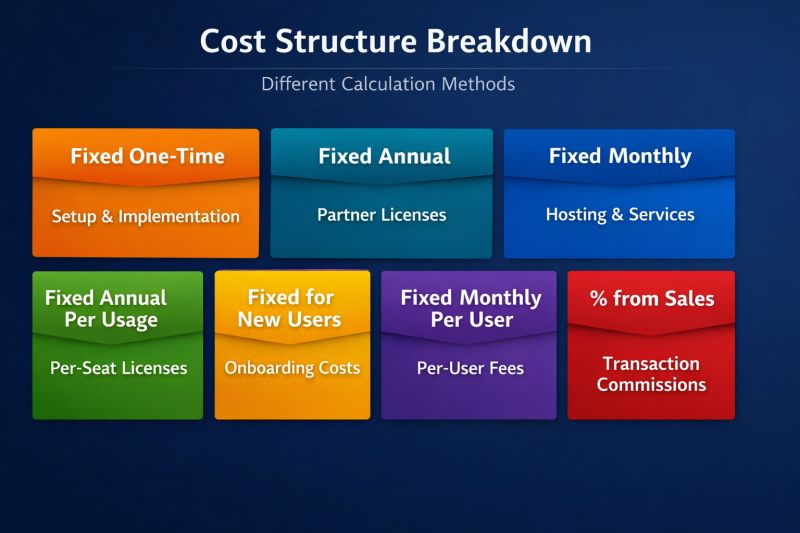
8. Cost Structure → Direct Costs & Cost Mapping COGS breakdown tied to products. Seven calculation methods because implementation costs, transaction fees, and SaaS licenses don't behave the same way.
9. What Canvas Can't Give You → Measurable Results P&L, Balance Sheet, Cash Flow — fully linked. Three scenarios in parallel. NPV, IRR, payback period. Break-even point. The numbers investors actually ask for.
Canvas gives you direction. Verter Studio gives you numbers that close rounds.
→ Canvas answers: "What is your business?"
→ Financial model answers: "Does it actually work?"
→ All blocks translated. One outcome Canvas was never designed to deliver.
View more articles
Learn actionable strategies, proven workflows, and tips from experts to help your product thrive.